Fashion Forecasting
Cultural
Forces:
-
Social media: It accelerates fast-moving trends and encourages to try bold aesthetics.
-
Gender fluid expression: Culture is shifting toward flexible identity and encouraging silhouettes that breaks gender norms.
-
Divided Cultural Expression: Intensified immigration enforcement creates fear that leads some to hide their cultural identity, while others respond by expressing it more openly as an act of solidarity.
Impact: Fashion will move toward louder, more expressive aesthetics that amplify identity, while at the same time creating a quieter,more subtle style for those who are overwhelmed by the stress of
current global events.
Economic
Forces:
-
Uncertain economic and politics: Constant shift in the economy and political climate make consumers feel unsure about their financial future. It leaves consumers with less disposable income for fashion purchases.
-
Inflation + increase tariffs: Prices have risen, especially for imported goods, making fashion more expensive. Shoppers are becoming more cautious and now prioritize affordable, versatile, long lasting basics over impulse buys.
Impact: Fashion will become more versatile and long-lasting garments that feel worth the investment.
Zeitgeist Mapping
Technological
Forces:
-
AI-driven creativity: AI helps designers generate ideas and test concepts quickly, allowing more imaginative silhouettes, texture, and proportions.
-
Algorithmic Personalization: Technology analyzes shopping habits, body data, and style preferences to recommend personalized clothing.
-
AR/VR & Virtual Try‑Ons: Brands use AR filters and virtual try‑ons, making consumers comfortable seeing themselves in exaggerated or digitally altered clothing.
Impact: These technological shifts will push fashion toward imaginative, digitally‑influenced silhouettes with customizable proportions and bold, screen‑ready aesthetics shaped by AI filters and virtual try‑ons.
Sustainability
Forces:
-
Eco-conscious clothing: More consumers want low-impact fabrics, pushing brands toward organic, recycled, and biodegradable textiles.
-
Ethical practices: Consumers expect brands to show where and how garments are made to increase pressure for ethical labor and transparency between supply chains.
-
Thrifting & Circular Fashion: Secondhand shopping, resale marketplace, and upcycling are increasing as people try to reduce waste and extend the life of clothing.
Impact: Design will be durable and sustainable materials that have a long time span. Circular fashion will inspire more upcycled, modular, and re-styleable pieces, making sustainability visible in both construction and overall aesthetic.
Trend Board

The Spring 2026 collections from designers such as Saint Laurent, Stella McCartney, and Tom Ford clearly reinterpret key elements of 1980s fashion, particularly power dressing and maximalism. In the 1980s, fashion reflected changing social roles, especially for women entering professional spaces, which led to the popularity of structured power suits, broad shoulders, and tailored silhouettes. These elements are visible in the 2026 collections through oversized jackets, exaggerated shoulder pads, bold colors, and voluminous garments. Additionally, the 1980s emphasis on glamour and excess which are seen in sequins, decorative details, and statement accessories. It is reimagined in modern runway looks through embellished fabrics, dramatic silhouettes, and oversized jewelry.
Today, these historic elements are updated to feel more expressive and less rigid than their original context. While 1980s fashion emphasized status, professionalism, and dress for success, the 2026 versions focus more on individuality and self-expression. Designers exaggerate proportions even further and mix bold prints, textures, and accessories to create a more playful and personal aesthetic. Retailers such as Zara and H&M translate these runway ideas into wearable pieces like floral dresses, chiffon blouses, and statement accessories, making the trend accessible to a wider audience. This trend makes sense right now because Gen Z and Millennials are moving away from minimalism and embracing bold, attention-grabbing fashion that communicates confidence, identity, and creativity in both everyday and professional settings.
Forecasting Board

Fashion is shifting away from today’s minimal, quiet-luxury tailoring and moving toward a more expressive, technologically influenced form of power dressing. While current trends emphasize clean line and soft neutrals, the next 1-3 years will introduce reflective materials, iridescent finishes, sculptural embellishments, and modular construction. Designers are beginning to treat the blazer as a space for identity expression through metallic lapels, pearl-accented shoulders, deconstructed cuts, and gender-full proportions.
This shift is driven by cultural and technological forces that demand from social media for visually striking, AI-enhanced creativity, and growing conversations around gender fluidity. Unlike the rigid, corporate authority of 1980s power dressing, this new direction is more experimental and emotionally expressive. It keeps the confidence of the 80s but evolves it through futuristic materials and fluid silhouettes, creating a modern form of power dressing aligned with today’s values.
History of a Fashion: Tailored Blazer
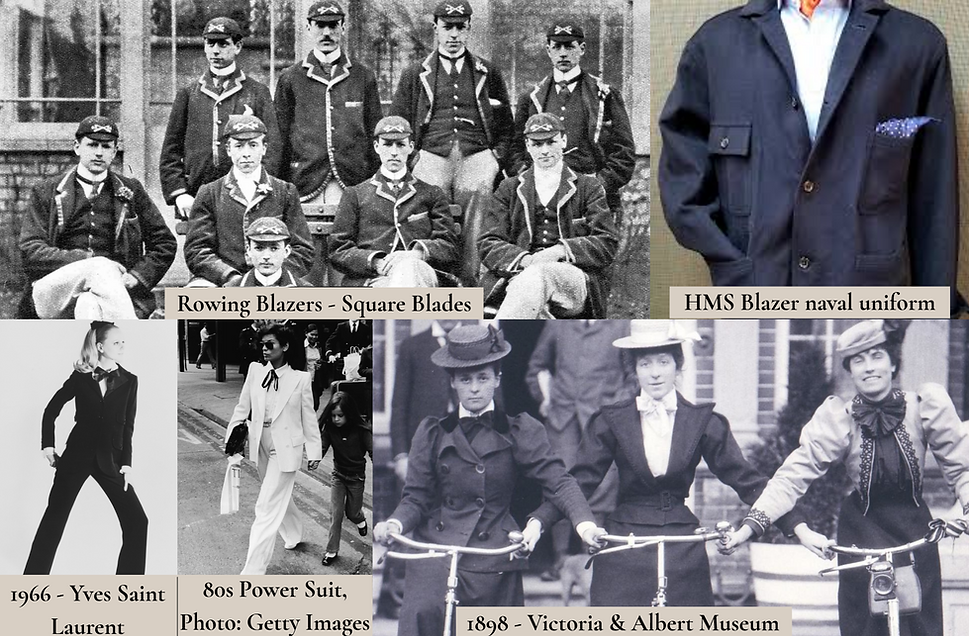
The blazer originated in the early 19th century within British boating and naval culture, where it was designed as a practical and distinctive uniform. Early versions were worn by rowing teams at Cambridge or by sailors on the HMS Blazer, often made from flannel and featuring structured tailoring and brass buttons (Shrimpton, 2014) & (Bass‑Krueger, 2019). By the late 1800s, the blazer had moved beyond uniforms and became associated with leisure, sports, and class identity. Its adoption by women in the 1890s marked an important cultural shift, as it aligned with increasing female participation in public life and more active roles outside the home (WILDFANG Editorial Team, 2023). Over time, the blazer continued to take on new meaning, especially during key moments like the suffragette movement, Yves Saint Laurent’s Le Smoking in 1966, and the 1980s power suit era, where it became strongly tied to ideas of empowerment and authority.
The reason the blazer keeps coming back is because it is both functional and symbolic. It communicates structure and confidence, but it is also flexible enough to be reinterpreted in different ways depending on the time period. For example, in the 1980s the blazer was very structured and emphasized power through broad shoulders and sharp tailoring, while more recent versions feel less rigid and more focused on self-expression. What stays the same is the basic structure of tailoring, lapels, and its balance between formal and casual wear which makes it a reliable wardrobe staple (Bass‑Krueger, 2019). However, what changes are the proportions, materials, and styling details, such as the shift from traditional flannel to more experimental fabrics or from fitted silhouettes to oversized and deconstructed designs.
Connecting this to my current trend and forecast, the blazer is once again being reinvented, but this time through a more expressive and technologically influenced lens. While it still carries the confidence associated with 1980s power dressing, it is evolving into something more experimental, with exaggerated proportions, reflective materials, and modular elements. This reflects current cultural and technological forces, like gender fluidity, social media influence, and AI-driven design. Overall, the blazer’s long history shows that fashion cycles are about adapting core pieces to fit new cultural meanings, which is why blazer continues to stay relevant today.
Source:
Bass‑Krueger, M. (2019, November 28). Everything to know about the history of the blazer. Vogue Australia.
https://www.vogue.com.au/fashion/trends/everything-to-know-about-the-history-of-the-blazer/image-gallery/dd07db6a3e45b3cbaff5851eb1b20398
Shrimpton, J. (2014, September). History in the details: Blazers.
https://www.thegenealogist.co.uk/featuredarticles/discover-your-ancestors/periodical/17/history-in-the-details-blazers-4604/
WILDFANG Editorial Team. (2023, January 11). The history of blazers: Born to be reinvented.
https://www.wildfang.com/blogs/the-wildfang-blog/blazer-origins-and-impact?srsltid=AfmBOooExhVOgKHmahOnk6hE0lgZJA2fOZC6Blnz9ZvvQ99kP1PXCElW